Looking for the right call center partner in Brazil?
BrazilDesk connects international companies with vetted Brazilian BPOs that match their scale, compliance needs, and industry. Get in touch with our team and let us handle the search for you.
💬 阅读这篇文章的中文版。
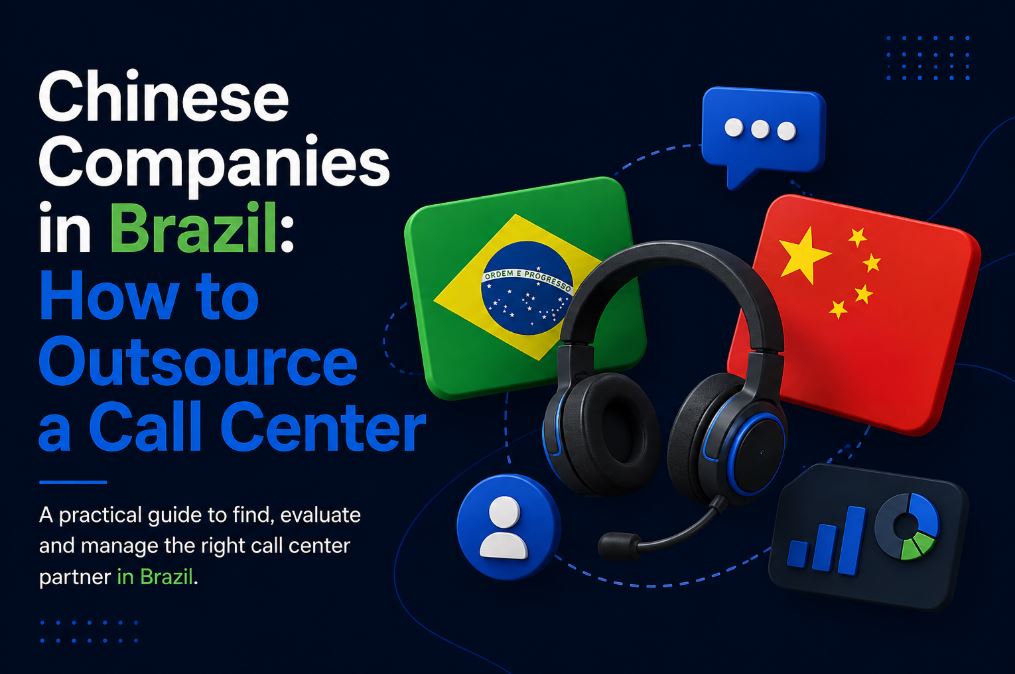
Do you represent a Chinese company expanding into Brazil and looking for the ideal call center?
In this article, we share our honest take on how Chinese companies can select the right partners, negotiate fair prices, and avoid future problems.
BrazilDesk is a company that helps international businesses in Brazil, from finding the right partner for a specific need to serving companies that need to outsource their customer support in the country.
Several Chinese companies have already reached out to us, and we have worked with a number of them, all of which keep growing in Brazil. The country has welcomed recent Chinese companies like Shein, BYD, Xiaomi, and ByteDance (our client), among many others, and recent data shows this expansion is not slowing down: in 2025, Brazil received US$6.1 billion in Chinese investment, 45% more than in 2024.
And many of these companies need something in common: local customer support, meaning outsourcing support to Brazilian companies within the country.
But if you have been tasked with finding a good BPO in the country, you are probably asking yourself:
- Which one actually has its own operation? There is a fear of subcontracting.
- Which one has 50 seats and which one has 5,000? There is a fear of scaling problems.
- Who already serves international companies? Many do not.
- Who can actually operate 24/7? Do these companies hire remote workers or work on-site?
- Who has experience with marketplaces, delivery, fintech, and similar industries, or will you have to start from scratch?
- Who is willing to start with 20 agents and scale to 300? Is there even physical space for that?
- Who can truly meet SLA requirements, beyond SLA, our compliance terms and procedural requirements?
Let’s walk through these questions and help you make the best decisions.
Before you start: define exactly what you need
Before looking for a BPO, it is important to have a clear vision of the operation you want to build.
How many agents will you need?
Will it run 24/7?
Will support be by voice, chat, email, or WhatsApp?
Will the service be limited to customer support, or will it also include technical support, back office, sales, or other functions?
It is also important to define, from the start, the main KPIs, the systems that will be used, the security requirements, the work model (remote or on-site), and how much the operation may need to grow in the coming months.
A BPO that can handle 20 agents during business hours may not be the same BPO that can hire and train 200 agents for a 24/7 operation. The clearer the scope, the better the comparison between vendors will be.
How do you know if a company’s information is actually reliable?
Chinese companies tend to have very rigorous compliance processes. I remember when we started providing services for ByteDance in Brazil, we ran into a few obstacles because they had more requirements than other companies. Later we came to understand that Chinese companies operate with different standards.
And that makes sense: if a company is on the other side of the world, it wants to be sure that if it contracted 150 seats at a call center, that provider is not subcontracting, or if the agreement was for on-site hiring, the workforce is not being split among remote agents.
So cultural differences and different ways of doing business can create delays or even friction between companies from the two countries.
Another factor is legal compliance. Many call centers follow Brazilian law, but do they know how it applies when working with a Chinese company on larger operations? Are they up to date on LGPD compliance and international data transfer requirements?
How can this be solved?
An intermediary company
One option is to work with a local intermediary company that can verify, and even inspect, the contracted call center and answer questions like: their real capacity is X, they can scale up to Y, they have already served clients A, B, and C, and so on. In other words, a company that can represent you in Brazil, act as the bridge between the contractor and the contracted party, and flag any issues.
Opening an office in the country
This tends to be the path most Chinese companies take as they expand in Brazil. Having an office, even a virtual one, staffed with Brazilian professionals, is an approach that can make a lot of sense. That way, most negotiations happen Brazilian to Brazilian. Still having a local representative is the most recommended path.

Cultural differences between Brazil and China
This point is often underestimated, but it deserves attention.
A Brazilian call center does not necessarily operate the same way a Chinese operation does.
Differences show up in:
- Customer communication
- Hierarchy
- How feedback is given
- Decision-making speed
- Relationship with employees
- Expectations around schedules
- Language
- Negotiation style
- Handling complaints
- Business posture
Even though large Chinese companies generally understand how business relationships work in the West, it is always important to adjust communication and also leave room for the Brazilian call center to apply local best practices when it comes to the relationship between the company and the consumer, along with some autonomy in decision-making.
One example is how your company handles returns, refunds, and customer-suggested changes. We have had Chinese clients with products that had a large user base in Brazil and received many complaints about slow support, something very simple to fix, but that involved enormous bureaucracy on the Chinese company’s side.
This made the Brazilian support team look inefficient, or even as if they did not care about the customer, and that can slowly damage a brand.

That is why it matters to align customer support with marketing. There is no point in your company advertising itself as the best if, the moment a user needs support, it turns into a huge headache.
It is very common today for Brazilians not to spend much time complaining directly to a company’s support line. They use sites like Reclame Aqui, which in a way shape a company’s reputation in Brazil based on user interactions, complaints, and how the company resolves them. They may also go straight to PROCON, Brazil’s consumer protection agency. Its role is to guide consumers, oversee companies, and help resolve consumer disputes.
How do you handle this?
It is very important that when your company looks for a call center in Brazil, it defines a highly efficient support and escalation scope. If the Brazilian call center needs authority to make a decision, and that decision has to be reviewed by multiple departments first, the operation will tend to run into serious problems.
So it is important that both companies come together and define:
- What are the best service channels for your product in Brazil?
- Who in China will be responsible for supporting the Brazilian team? Will there be an SLA for that Chinese team too?
- How will meetings be run, and which KPIs will be reviewed, and how often?
- How will support be evaluated? What about improvements and new implementations?
These are all questions that need to be worked through to avoid friction down the line.
After all, on one side, the Chinese company is looking for efficiency, good costs, and solid delivery. The Brazilian company is looking for contracts with large clients. In the middle of it all is the customer, and a slow, complicated, or careless process can generate unprecedented costs for the contracting company.

The language barrier
It is not just Portuguese versus Chinese.
There is a third, very important language: English.
Picture the chain:
Headquarters in China → Brazilian manager → supervisor → agent → Brazilian customer
If communication between headquarters and the BPO happens in English, problems can arise in:
- Documentation
- Training
- Scripts
- Reports
- KPIs
- Meetings
- Crisis management
- Contract interpretation
So it is practically mandatory that the people acting as intermediaries in this relationship speak fluent English. The Chinese team will not communicate directly with front-line agents, who likely will not need to speak English, but team leaders, support managers, supervisors, and everyone above them needs to be on the same page.
How can this be solved?
Hold meetings with the responsible team and check the English communication skills of that team.
You need to know exactly who to talk to when something serious comes up, and it should be a group of people, not just one person who handles everything. The people below that Brazilian manager also need access and familiarity with your team, otherwise communication problems will keep piling up.
Picture this situation: the team leader, or part of the team, keeps receiving complaints that the support system they are using is too slow. However, that system was recommended by the manager, and it is a system the company tries to standardize across all its clients. It is important for your company to have clarity on the problem and to suggest, or if truly urgent, require the change.

So keeping open communication across several levels of the operation at the contracted company is essential, along with reviewing reports regularly.
One option is to hire an operations manager to work directly alongside the call center.
What does that look like? In the example above, say the manager does not want to switch support tools. The reason could involve costs, training, company standardization, proprietary systems, partnerships with other companies, who knows.
If you have someone inside the company overseeing these processes, but who is not employed by the call center itself, it is like having your own eyes inside the operation at all times and avoiding any favoritism.
One negotiation approach could work like this: the call center provides 80 support agents, for example, and you separately hire a Brazilian supervisor and coordinate that arrangement with the call center.
Depending on the size of the operation, you might have more than one employee in Brazil to make sure everything stays on track.
Partnering with a Brazilian law firm experienced in international contracts is equally important.

Technology integration
This can be a major hidden problem.
A Chinese company may arrive in Brazil with its own systems: CRM, ERP, service platform, cloud, telephony, AI, and so on.
The Brazilian BPO will need to integrate with that environment.
For example, I love using Lark, but no one in Brazil uses it.
So it is necessary to check:
- API
- CRM
- Telephony
- Call recording
- Data storage
- WhatsApp integration
- Authentication
- Access control
- Cloud infrastructure
- Cybersecurity
It is also important to define who provides and who pays for each piece of technology. Does the client provide the CRM? Does the BPO provide computers and telephony? Who pays for the integration? All of this should be defined before the operation begins.
If any systems are hosted in China, the question of personal data and international transfer comes up again, and both parties need to make sure they are complying with Brazilian law.
On top of that, Anatel, Brazil’s telecommunications regulator, has specific rules for the sector and has been reinforcing cybersecurity requirements.
Labor law and liability risk
This is a point a foreign company needs to take very seriously.
Brazilian call centers are labor-intensive operations. So the vendor needs to have a very well-organized labor structure.
The Chinese company should look into:
- Employment model (CLT or independent contractor)
- Work hours and rules that apply to the operation
- Overtime
- Benefits
- Turnover
- Vacation policy
- Leave of absence
- Unions
- Health and safety
- Labor liabilities
- Ongoing lawsuits
- Tax compliance
Remote hiring
Beyond that, it is not enough to simply add a clause saying “the BPO is responsible for everything.” A proper legal review of the outsourcing structure and the responsibilities involved is necessary.
In a way, one of the benefits of outsourcing is not having to deal with all the related red tape. Even so, especially for large companies, it is important to show that you understand how the company treats its employees, whether it follows good hiring practices, offers real opportunities, is accessible, and meets its legal obligations.
How can this be solved?
Ask the company to explain, in writing and in the contract, how its hiring process works and how agents will be brought on to support your customers. You can also set requirements around hiring practices, require the company to meet its legal obligations, and require transparency about how this type of business operates.
It matters to partner with companies that operate within the law and maintain good relationships with their employees, because at the end of the day, those are the people who will be serving your customers.
While it is not your responsibility to manage the outsourced staff the way an HR department would, it is important to make clear that your company values strong internal relationships and local legal compliance.

High turnover
This is one of the most important operational problems in the industry.
Imagine a company hires a BPO with 50 agents.
The vendor trains all of them over several weeks.
Then, some of those agents leave and need to be replaced.
The company ends up indirectly paying for:
Recruiting → selection → training → lost productivity → retraining.
That is why I would treat turnover as a mandatory KPI when selecting a vendor.
I would not just ask:
“How much does one agent cost?”
I would ask:
“What is the monthly turnover for this operation, and how do you calculate it?”
You can also ask upfront about the vendor’s turnover with other clients, then compare it with your own numbers once the contract is underway. And, of course, dig into the reasons behind the turnover and put measures in place to reduce it as much as possible.
It is also worth asking about absenteeism, because an operation can have low turnover and still suffer from absences that hurt the SLA.
Quality and reputation risk
For a company entering Brazil, the call center will often be, in practice, the face of the company to the Brazilian consumer.
If the service is poor, the consumer will not think:
“The outsourced BPO gives bad service.”
They will think:
“This Chinese company gives bad service.”
And as mentioned earlier, sites like Reclame Aqui can rank prominently in Google. So when people search for your company in Brazil and see negative comments, they may decide not to buy from you.
That is why the contract should include KPIs such as:
- NPS
- CSAT
- FCR
- AHT
- Service level
- Abandonment rate
- Conversion rate
- Call quality
- Complaints
- Script adherence
- Compliance
It is also worth remembering that Anatel (National Telecommunications Agency) oversees abusive calls and telemarketing practices, including measures related to short calls, authentication of high-volume callers, and fraud prevention, where applicable to the operation.
Lack of transparency around the real cost
A BPO might quote something like:
US$X per seat per month.
But that is not necessarily the total cost.
You need to find out whether the quote includes:
- Recruiting
- Training
- Supervision
- Technology
- Telephony
- Call recording
- CRM
- Infrastructure
- Management
- Overtime
- Weekend work
- Contingency
- Integration
- Reporting
- Implementation
That is why I would recommend comparing vendors using TCO, or Total Cost of Ownership, instead of simply comparing “price per agent.”
It is also important to understand whether pricing is per seat, per productive hour, or per contact. Two vendors can quote different prices, and even so, the one that looks cheaper per seat may not end up being the cheapest overall.
I would break vendor selection down into five dimensions:
| Dimension | Approximate weight |
|---|---|
| Compliance / LGPD / security | 25% |
| Operational capacity | 25% |
| Technology | 15% |
| Quality / customer experience | 15% |
| Price | 20% |
I would not necessarily pick the cheapest vendor, but the one that balances all of the points above.

Negotiate in reais or in dollars?
I would say the bigger question is not really the currency, but the final cost. That said, currency does raise some interesting points.
For Chinese companies, negotiating in dollars tends to be more convenient, since they usually have clients around the world and managing payments across multiple currencies can get chaotic due to exchange rate swings.
For the Brazilian BPO, it is much more convenient to be paid in reais, because of how much the exchange rate can move day to day.
Of course, this depends on each negotiation, but one workable model is:
A contract in USD with a currency adjustment clause.
This can work quite well.
For example:
US$1,500 per agent per month, with a review or adjustment if the USD/BRL rate moves more than 5% from the base rate.
Example:
Base rate: US$1 = R$5.00
Price: US$1,500 = R$7,500
If the dollar drops to R$4.50, a contractual clause allows the price to be adjusted.
This reduces the risk for the BPO.
It is also important to keep the currency adjustment separate from the annual cost adjustment. They are two different things.
Work with one vendor or multiple vendors?
When we talk about large operations that start with 100 people, for example, and quickly grow to 200 or 300, it is worth asking: should you work with just one vendor, or two or three?
There are pros and cons to consider.
Pros
- You are not dependent on a single vendor. If a problem occurs, or the operation goes down for a few hours, that already puts the entire operation at risk. Having more than one vendor turns out to be useful.
- Faster growth with less risk. Not every call center can hire 50 people in a short window, so splitting that demand between two vendors is often more realistic.
- It gives you a way to compare performance. Say you have two vendors, A and B. Vendor A delivers a 93% SLA and Vendor B delivers 75%. Something is clearly going wrong at Vendor B. The same goes for other metrics that can be compared and adjusted. If the service processes are the same across both call centers, almost like a franchise model, you can spot the differences clearly.
- You can split responsibilities. Instead of having two call centers doing the exact same work, you can divide it up: one focused on general support, the other on technical support; one on voice, the other on ticket-based support.
- It avoids concentration risk. Say you start with a call center of 100 people and, within a year, you are at 200. What happens if there is an internal change that affects your operation? A change in leadership, labor issues, financial trouble, a drop in quality? Switching vendors overnight is very difficult when your entire process lives inside a single company. With two vendors, it is much easier to spread out that risk.
Cons
- More management overhead. You are not just hiring two BPOs, A and B. You are managing Vendor A plus Vendor B, meaning two systems, two teams, two managers, two contracts, two sets of KPIs, and two operational cultures. Multi-vendor setups increase both cost and governance complexity.
- Service inconsistency. If training and operations are not identical, end customers may notice a difference in how the company treats them, since the two vendors are running support in different ways, which also complicates management overall. Who is delivering better service, and why?
- Harder to make sweeping changes. If you want to keep more than one call center, the processes need to stay aligned as long as the service, customer, and end product are basically the same. Now, what if you need to make a significant change to one of them? It will need to happen at the other one too. So the processes need to be very clearly defined and reviewed.
The best way to handle this is to start operations with one strong vendor, build a well-structured process, almost like a franchise model, and once you hit a certain number of seats, replicate the process that has proven to work with a new vendor, then monitor to make sure it is working.
Start with a pilot and have an exit strategy
For larger operations, a good approach is to start with a pilot project before scaling the full operation. For example, start with a smaller team, track the KPIs, check communication between both companies, and understand how the BPO really works before increasing the number of agents.
It is also important to plan for what happens if you need to switch vendors down the road. The contract should clearly spell out how the transition will work, how data will be returned or deleted, how knowledge will be transferred, and what support will look like during the change.
How can BrazilDesk help?
BrazilDesk is a boutique call center. We work with small support teams, and when a Chinese company comes to us with a large demand, we connect them with call centers that handle bigger operations and meet the requirements your company needs.
Here is how it works. You reach out to us by email (hello@brazildesk.com) or through our contact form and share your demand and requirements.
We put together quotes with three call centers that fit your needs, send you those quotes along with a summary of each vendor, and schedule and join the initial meetings with you, so you can close the deal with more confidence and less stress.
We already have a number of partners for large projects, but we are also always looking for new solutions for new demands.
If you would like to work with us, just get in touch.
Note: This article is a practical business guide and is not a substitute for legal, tax, labor, or regulatory guidance from qualified professionals in Brazil.
Ready to find the right call center partner in Brazil?
BrazilDesk vets Brazilian BPOs on compliance, scalability, and industry experience, so you do not have to figure it out alone.

🎁 A gift for you!
We prepared this checklist, so you won’t feel lost negotiating with Brazilian vendors.
Checklist: Choosing a Call Center in Brazil
Before signing with a BPO in Brazil, use this checklist to make sure you have covered the key areas that most often cause problems for foreign companies. Print it, share it with your procurement and legal teams, or use it as a scorecard when comparing vendors.
1. Scope and requirements
- ☐ Defined the number of agents needed, now and at scale
- ☐ Decided whether the operation needs to run 24/7
- ☐ Chosen the channels required (voice, chat, email, WhatsApp)
- ☐ Confirmed whether support includes technical support, back office, or sales
- ☐ Set the main KPIs and reporting frequency in advance
- ☐ Decided on work model: remote, on-site, or hybrid
2. Compliance and reliability
- ☐ Verified the vendor’s real operational capacity, not just what is advertised
- ☐ Confirmed whether the vendor subcontracts any part of the operation
- ☐ Checked the vendor’s experience with international clients
- ☐ Reviewed the vendor’s LGPD compliance and data transfer practices
- ☐ Considered working with a local intermediary to verify and vouch for the vendor
- ☐ Evaluated whether a local office or representative makes sense for your operation
3. Culture and communication
- ☐ Aligned expectations on decision speed, hierarchy, and feedback style
- ☐ Defined how much autonomy the Brazilian team will have to resolve issues
- ☐ Set a clear escalation path that does not require multiple approvals for simple decisions
- ☐ Confirmed English fluency for managers, supervisors, and team leads
- ☐ Assigned a point of contact on the China side with a defined SLA
- ☐ Considered hiring an independent operations manager in Brazil to oversee the partnership
- ☐ Have a Brazilian law firm with international contract experience on standby
4. Technology
- ☐ Mapped which systems need to integrate: CRM, ERP, telephony, WhatsApp, cloud
- ☐ Defined who provides and who pays for each piece of technology
- ☐ Confirmed data storage location and international transfer compliance
- ☐ Reviewed cybersecurity and access control requirements
- ☐ Checked Anatel requirements if the operation involves telecom or calling
5. Labor and legal risk
- ☐ Reviewed the vendor’s hiring model (CLT vs. independent contractor)
- ☐ Requested written explanation of hiring practices and legal obligations
- ☐ Checked for pending labor lawsuits or liabilities
- ☐ Confirmed tax and fiscal regularity
- ☐ Reviewed union relationships and any history of labor disputes
6. Turnover and workforce stability
- ☐ Asked for the vendor’s monthly turnover rate and how it is calculated
- ☐ Asked for turnover history with other clients
- ☐ Asked about absenteeism rates, not just turnover
- ☐ Included turnover as a contractual KPI
7. Quality and reputation
- ☐ Set clear KPIs: NPS, CSAT, FCR, AHT, service level, abandonment rate
- ☐ Included quality-of-call and script adherence metrics
- ☐ Planned for monitoring public reputation channels (e.g. Reclame Aqui)
- ☐ Aligned marketing promises with actual support capacity
8. Cost and contract structure
- ☐ Requested a full cost breakdown, not just price per seat
- ☐ Compared vendors using Total Cost of Ownership (TCO)
- ☐ Confirmed whether pricing is per seat, per productive hour, or per contact
- ☐ Decided on contract currency (USD, BRL, or USD with exchange rate adjustment)
- ☐ Separated currency adjustment clauses from annual cost review clauses
9. Vendor strategy and growth
- ☐ Decided between single-vendor and multi-vendor strategy
- ☐ Planned for a pilot phase before scaling the full operation
- ☐ Defined an exit strategy, including data return and knowledge transfer
- ☐ Documented processes clearly enough to replicate with a second vendor if needed
Not sure where to start on this checklist?
BrazilDesk can walk through this list with you and connect you with vetted call centers that fit your requirements.